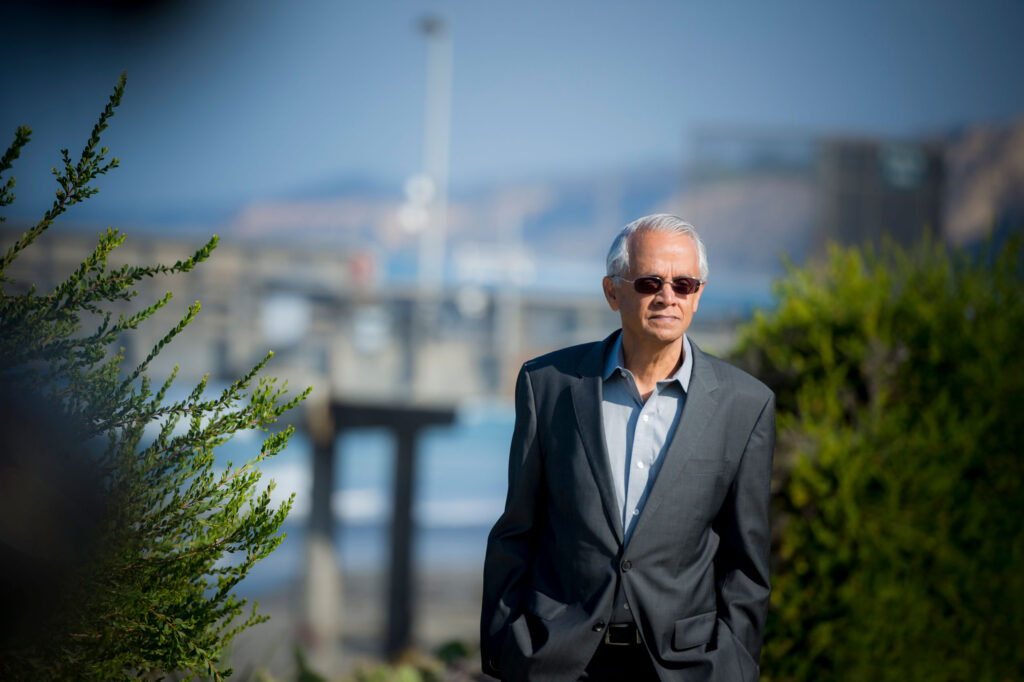
 Professor Ramanathan, a climate science pioneer, received the Volvo Environment Prize in 1997.
The Volvo Environment Prize event 2023 starts soon.
Climate change may soon reach a critical turning point—a so-called “ozone-hole moment”—according to leading climate scientist Veerabhadran Ramanathan.
Professor Ramanathan, a climate science pioneer, received the Volvo Environment Prize in 1997.
Veerabhadran Ramanathan, a Professor at the Scripps Institution of Oceanography at the University of California and a pioneer in climate science, has warned that humanity may be underestimating the urgency of climate change because of a lack of visible, immediate impacts.
During a recent visit to the Royal Academy of Sciences in Stockholm, Professor Ramanathan expressed concern over what he sees as a global backpedaling on climate mitigation efforts.
“Many people think climate change is happening somewhere else. It isn’t touching them yet,” Ramanathan told attendees at the Academy.
“I worry that in five years, maybe sooner, we will have our ozone-hole moment on climate. Only then will we act,” he added, referencing the historic turning point in environmental action triggered by the discovery of the ozone hole in the 1980s.
Ramanathan drew a parallel to the debate over chlorofluorocarbons (CFCs) in the 1970s, when early warnings about ozone depletion were met with industry resistance. The discovery of the ozone hole over Antarctica in 1985 led to swift global action, including the signing of the Montreal Protocol in 1987, which phased out CFCs.
“I think the climate ozone-hole moment will come soon,” Ramanathan said. “In the next 5–10 years, climate change will move into our living rooms worldwide. Unfortunately, I think that is what it takes before we will see action.”
Ramanathan was awarded the Volvo Environment Prize in 1997 for his research on how atmospheric particles and gases contribute to climate change. He shared the honor with Syukuro Manabe of Princeton University, a climate modeling pioneer who predicted global warming.
Manabe went on to receive the Nobel Prize in Physics in 2021 for his work, while Ramanathan has continued to receive international recognition, including the prestigious 2026 Crafoord Prize in Geosciences, which brought him to Sweden, the city of Lund, and also to the Royal Academy of Sciences in Stockholm.
Despite such early recognition, the delay in broader acknowledgment of their research raises questions about the pace of global response to climate science.
“Our research was recognized by the IPCC,” Ramanathan noted.
“But polarization soon set in among the general public,” he added.
“However, our predictions have come true—one after another. And during the last 15 years, the pace has accelerated beyond our expectations,” Ramanathan said.
“But I am still hopeful,” he concluded. “We can still fix this.”